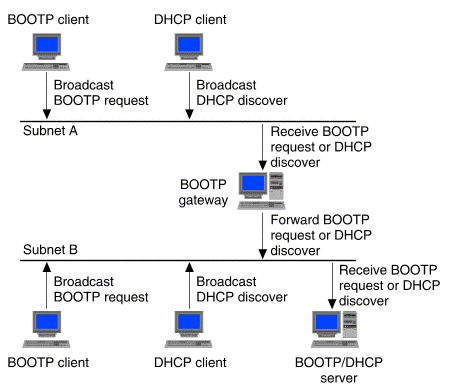
A BOOTP client uses the command bootp(1Mtcp) to broadcast a request for information from any BOOTP server that has been configured to respond to it on the local subnet. If a BOOTP server has not been configured to reply on the local subnet, a local machine can be configured as a BOOTP gateway which uses bootpgw(1Mtcp) to forward a request to a server or gateway on another subnet. You can also use a BOOTP gateway to forward DHCP discover messages between subnets.
You can also use a BOOTP gateway to broadcast BOOTP replies on a subnet. Some older BOOTP clients will only accept BOOTP replies that are broadcast.
``Using a router as a BOOTP gateway'' shows how a BOOTP gateway configured on a router could be used to receive BOOTP requests and DHCP discover messages from subnet A which does not have a BOOTP or DHCP server, and forward these to BOOTP and DHCP servers on subnet B.
Using a router as a BOOTP gateway
When a BOOTP server receives a request from a client for which it holds configuration information, it uses the bootpd(1Mtcp) daemon to reply directly to the client, possibly via a BOOTP gateway, without broadcasting. The BOOTP configuration database is maintained in the file /etc/inet/bootptab on the server (see bootptab(4tcp)).
Clients can obtain their initial network configuration from a BOOTP server at installation time. If the characteristics of the network change at a later time, (for example, if the domain name changes, or if the client moves to another subnet) you can update the clients' local configuration files (for example, /etc/hosts or /etc/resolve.conf) from the BOOTP server to reflect the changes.
In addition to simplifying the client installation and configuration process, the UnixWare implementation of BOOTP also simplifies administration of the configuration database on the BOOTP server. If, for example, your BOOTP server is going to support 300 client hosts, you typically do not need to set up a bootptab file containing 300 fully defined client entries. Instead, you can set up a bootptab file that contains entries at three levels:
See also: