DNS domain names and host names
DNS domain names are structured as a listing,
from left to right, of the
domain name space traced from the host to the root.
For example, in the DNS
name volga.mynet.com.,
the host, volga, appears in the
domain mynet.com.,
which is a subdomain of com.,
which is a domain under the root ``.''.
NOTE:
Specifying the root domain is usually optional;
when indicated, it is shown as a trailing period or ``dot''.
However, when configuring DNS, it
is necessary to specify the root domain
to prevent the current domain origin being appended.
The diagram below compares the domain naming scheme to
UNIX pathnames.
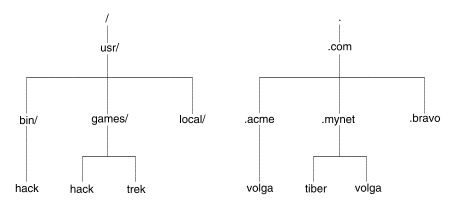
The domain naming scheme and UNIX pathnames
are similar in the following ways:
-
The root domain ``.'' and the root directory ``/''
are both entities in their own right. Otherwise these symbols merely serve
to delimit the components of a domain name or a pathname respectively.
-
Each name specifies its location in a tree. For example, the pathname
/usr/bin and the domain name acme.com.
-
Each name need only be unique within its portion (domain or directory)
of the tree. For example, two files can be named hack and two hosts
be named volga.
-
Each name can be relative or absolute (fully qualified).
A fully qualified domain name ends at the root domain, indicated by a
trailing dot (example: volga.mynet.com.).
A domain name minus the dot may be seen as a relative domain name
(example: volga.mynet). Again, parallels exist with the
UNIX filesystem, in which the file /usr/bin/hack may be
indicated as /usr/bin/hack (its absolute name) or
simply hack (its relative name if the directory
is known to be /usr/bin).
However, note that the domain naming scheme differs from
UNIX pathnames in the following ways:
-
Domain names are written with the root domain at the right-hand side;
UNIX pathnames are written with the root directory at the left-hand
side.
-
Domain names are case insensitive; UNIX pathnames are case sensitive.
-
The domain name scheme allows a maximum depth of 127 domain levels
below the root domain.
UNIX filesystems are usually limited by the maximum
length allowed for a pathname.
© 1999 The Santa Cruz Operation, Inc. All rights reserved.
UnixWare 7 Release 7.1.1 - 5 November 1999