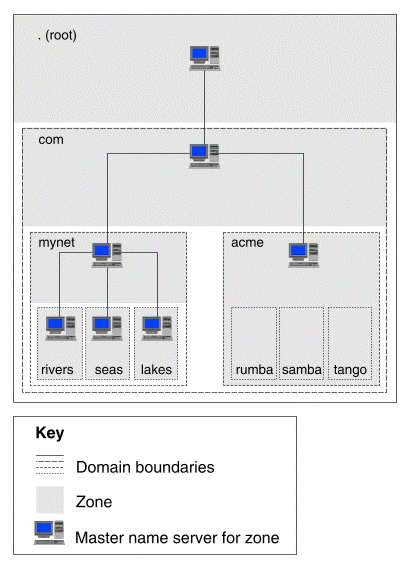
DNS uses a client/server architecture to maintain and distribute host names and IP addresses on networks ranging from small local area networks to the entire Internet. Under DNS, the Internet consists of a hierarchy of domains. This hierarchy, referred to as the ``domain name space'', is organized as an inverted tree radiating from a single root, much like a UNIX filesystem:
Domain name space
The ``root domain'', ``.'', is the base of the tree. Final attempts to resolve names to IP addresses take place here if lower-level servers do not have the requested data. The root domain is usually omitted from domain names. For example, ``volga.rivers.mynet.com.'' is usually written as ``volga.rivers.mynet.com'', that is, without the trailing ``.''. Usually this doesn't affect looking up IP addresses, however the ``.'' is usually vital when configuring DNS data.
A ``domain'' is a subset of the domain name space. The mynet.com and acme.com domains share the com portion of their domain name because they both lie within the com domain. Thus all domains are effectively part of the root domain.
A ``subdomain'' or ``child domain'' is a domain that branches off another. For example, in the diagram rivers.mynet.com, seas.mynet.com and lakes.mynet.com are subdomains of mynet.com. All domains except the root domain are therefore subdomains of another domain.
A DNS ``master name server'' is a computer that maintains host name and address databases for one or more zones. Zones usually also have ``slave'' name servers which act as backup servers should the master name server be unreachable or down.
A ``zone'' is a portion of the domain name space that is served by a master name server and one or more slave name servers. Depending on how the person responsible for administering a zone has configured it, a zone may correspond to an entire domain, a domain with all of its subdomains, or a portion of a domain. In the diagram, the zones in mynet.com correspond to the subdomains rivers.mynet.com, seas.mynet.com, and lakes.mynet.com plus the portion of the mynet.com domain that excludes these subdomains. Each of these zones is assigned its own master name server which maintains zone information for its assigned portion of mynet.com. Compare this with acme.com where a single master name server maintains the zone information for the entire domain including its subdomains rumba.acme.com, samba.acme.com, and tango.acme.com.
A ``client'' is a networking program running on any machine which needs to find information about a host. The ping, rlogin, and telnet utilities are examples of clients. Usually, a client wants to discover the IP address associated with a given host name. How a client actually obtains the information depends on how its host machine is configured to obtain (or ``resolve'') host names to IP addresses. One way to resolve host names is to use DNS but it is also possible to obtain IP addresses from the /etc/hosts file or from an NIS map. The latter methods are only really suitable for a small-scale LAN or WAN.