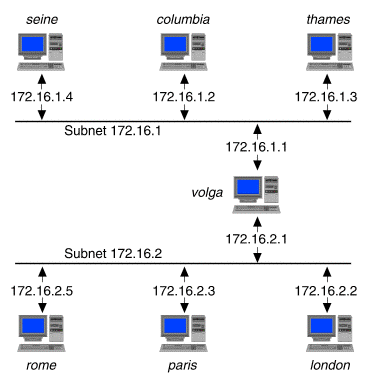
A TCP/IP network usually interconnects a number of hosts. Your UnixWare® host is connected to a TCP/IP network via a hardware network interface. Individual TCP/IP networks are in turn interconnected via IP routers. IP routers forward IP packets from one TCP/IP network to another and exchange routing information with each other to deliver packets across a number of networks. Other types of routers may forward traffic for protocol families other than TCP/IP.
If all of the hosts at your site are connected to a single TCP/IP network that is not interconnected with any other TCP/IP networks, an IP router is unnecessary. If your site comprises many TCP/IP networks, or if you want to interconnect your network with other TCP/IP networks, you must configure the interconnections with IP routers so that all hosts can communicate.
Many types of machines may serve as IP routers. A number of vendors offer machines dedicated entirely to the function of IP routing. A system may act both as a host (offering network services such as remote login) and a router.
The IP routing mechanisms consist of:
On a more complex network, that is, a network in which a router connects a local network to other routers and gateways, configure the router to use dynamic routing tables. Dynamic routing tables allow the router to route traffic to the most current gateway destinations.
A router can build and maintain a dynamic routing table by running a routing daemon such as routed or gated. The routing daemon manages its routing table by exchanging routing information with gateways and other routers. When routed runs on a router, it broadcasts its routing table and listens for broadcasts from other directly connected routers. It continually updates its routing table based on those broadcasts. A routing daemon that both broadcasts its routing tables and listens for broadcasts from other routers is termed ``active''.
A routing daemon can also run on a host that itself is not a router. In this case, the daemon is configured to listen for broadcasts and update its local routing table; it does not broadcast to other machines. This is termed ``passive''. When a machine can send an IP packet to another machine without going through a third machine, the route the packet will travel is said to be a ``direct route''. The selection of that route is called ``direct routing''. In ``Example internetwork'', the machine columbia can trace a direct route to the machines seine, thames and volga on the 172.16.1 network. columbia cannot reach rome, london or paris directly.
Example internetwork
When a machine wishing to send an IP packet to a second machine must send that packet through a third machine, the route the packet will travel is said to be an ``indirect route'' and the selection of the intermediary machine is called ``indirect routing''. The intermediary machine, a router, has connections to more than one network and is said to provide a gateway between the networks. Therefore, a router may also be called a ``network gateway''. In ``Example internetwork'', the machine volga is a network gateway between the 172.16.1 network and the 172.16.2 network. If the machine seine needs to send an IP packet to paris, it must send the packet to volga, which forwards the packet to paris.
The above example is a simple but common scenario, however, sometimes the source and destination hosts can be several networks, and thus routers, away from each other.