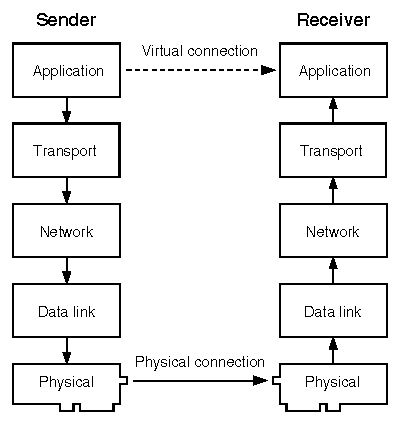
The TCP/IP protocols enable communication between pairs of hosts, or ``peers'', on a network. The TCP/IP protocol structure can be conceptualized as a series of layers, or ``stack'', between an application and the network. Each protocol layer on one peer has a corresponding layer on the other peer. To the application, it appears that it has a virtual connection to an application running on another host. In reality, data is passed over the network in the physical form that the network can handle. Each layer is required, by design, to handle communications in a predetermined fashion. Each protocol formats communicated data and appends information to or removes information from the data. Then the protocol passes the data to a lower layer on the sending host or a higher layer on the receiving host, as illustrated in ``Sender/receiver interaction''.
Sender/receiver interaction
The interface between the application and the transport layers is termed a transport interface. Interfaces such as sockets and TLI/XTI eliminate the need for applications to know about the transport layer in detail. For more information about programming transport interfaces, see Using network programming interfaces.
The next sections briefly explain how each protocol layer handles messages, starting with the lowest layer. For more detailed information about each protocol, refer to the appropriate manual page.