Implementing NDS on a small sized network is typically based on two possible models:
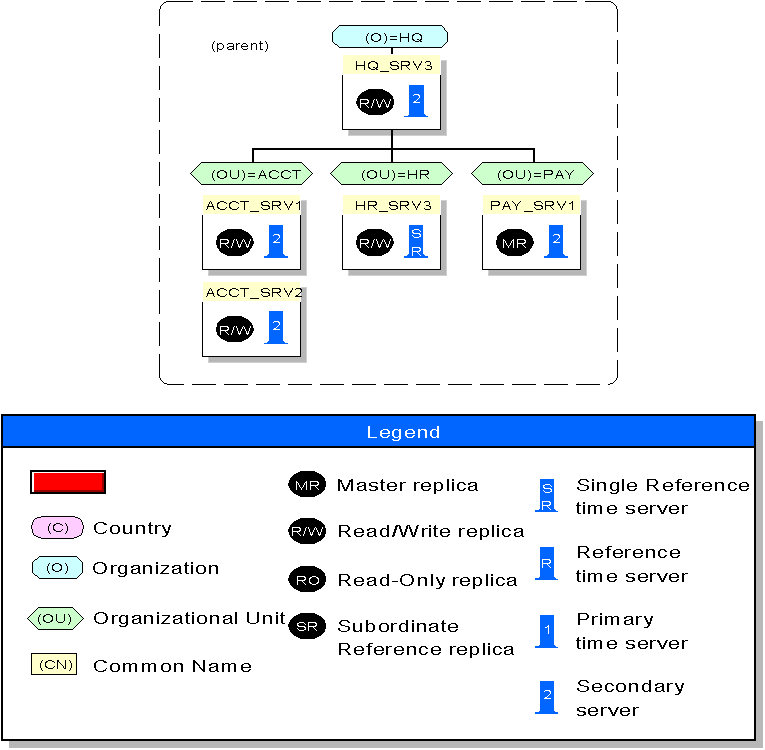
Example of a Small-Sized Directory Tree
Small-sized networks are commonly site-, workgroup-, and department-oriented in structure. They are easily managed by a system-wide administrative group with central management at the organizational and departmental levels.
The Directory tree begins with a single Organization object with few or no Organizational Unit objects below. If Organizational Units exist, they are based on functional groups, projects, departments, and so on, within a single site.
Resources are usually shared by all network users and groups.
Although small-sized business might be restricted to a single- or multiple-segment LAN, time services is still important.
A Single Reference time server is usually adequate for LAN-based networks. The Single Reference time server is monitored and periodically adjusted for time by the network supervisors.
All other servers in the network are designated as Secondary time servers.
Workgroup boundaries generally determine the number of partitions required in a tree. You should partition your tree in relation to the use and physical location of network resources. You should create partitions only if they provide better performance or fault tolerance to the network and tree. Small networks may not require partitioning.
If you think it is necessary, create a small number of partitions at the top levels of the tree.
Each server on the network should contain all the resources needed at its location, because small-network users rarely connect to servers at other locations. Replicas, in this case, will most likely not decrease WAN traffic.
However, replicas provide fault tolerance. You should copy two to three replicas of each partition somewhere on the network to provide fault tolerance.