If users are accessing the Directory tree through a WAN link, you can place a read-only replica of the necessary partition on a local server so they don't need to cross the WAN link.
Storing a read-only or writable replica on servers that are across a WAN link can be helpful because it cuts down on the traffic that has to cross the link when users try to access that partition's information. Nevertheless, there will be some increase in traffic due to the synchronization of replicas.
Note that read-only replicas do not support user login. Do not create a read-only replica of a partition that users must attach to before they authenticate to the network.
With a replica of a distant partition stored locally, users have immediate access to the objects they need. The only time Directory information crosses the link is when replicas are being updated.
However, remember that every server that carries a replica must receive all changes to any object within that partition. The more replicas of a given partition you have, the more time needed and the more WAN traffic that exists to fully synchronize the replicas.
Before you begin distributing replicas, think about how much data you want in a partition. Because replicas are stored on servers, unnecessary information in a replica is an inefficient use of disk space and network traffic.
If a partition becomes very large, and you only need to replicate a portion of it, you can use utilities to split the partition and replicate only the necessary portion.
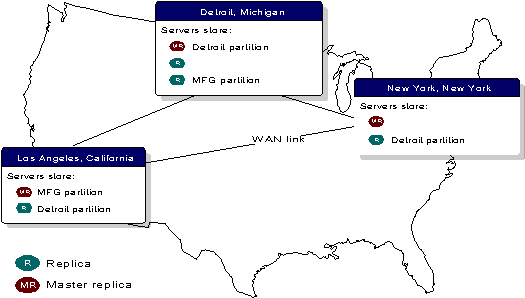
The following figure shows one way to distribute replicas across the WAN on our example tree:
Replica Distribution across a WAN
This example reflects the following: