Reference time servers provide a time that Primary and Secondary time servers and client workstations can synchronize with.
Reference time servers can be synchronized with an external time source, such as a radio atomic clock.
A Reference time server acts as a central point of control for time on the network. Eventually, all Primary time servers adjust their clocks to agree with a Reference time server.
Reference time servers do not adjust their internal clocks; instead, Primary and Secondary servers' internal clocks are adjusted to synchronize with the Reference time server.
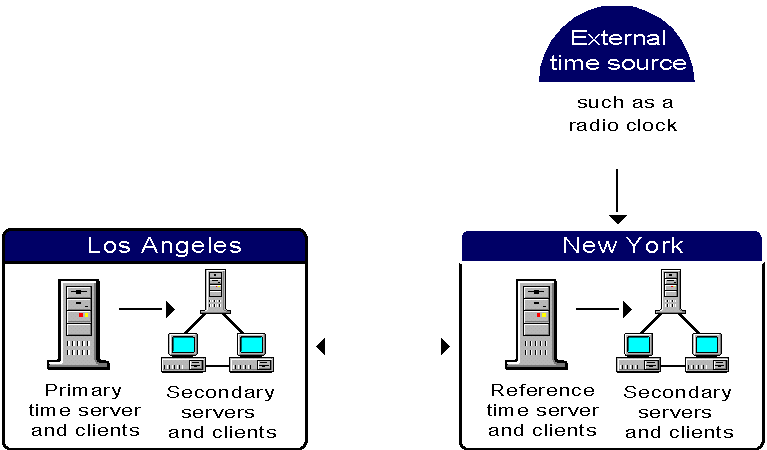
The following figure shows a Reference time server synchronized to an external clock. The Reference time server, in turn, provides time to Secondary servers and client workstations, as well as to a Primary time server at another location.
Reference Time Server
Use a Reference time server when it is important to have a central point of control for time on the network. Usually, only one Reference time server is installed on a network. If you use more than one Reference time server on a network, you must synchronize each Reference time server with the same external time source, such as a radio atomic clock.
You must have at least one Primary time server that the Reference time server can contact in order to synchronize time on the network.
Whenever Primary and Reference time servers are on a network, they must be able to contact each other for polling and synchronization.